
 Italiano
The Limiting Oxygen Index (LOI) determines the minimum oxygen concentration required to sustain the combustion of a polymeric material. The method is widely used in research, flame-retardant formulation development and quality control.

Automatic EA04 system for Limiting Oxygen Index determination.
What is the Oxygen Index?
The Oxygen Index, referred to as LOI (Limiting Oxygen Index) or OI (Oxygen Index), expresses the minimum volumetric concentration of oxygen in an oxygen/nitrogen mixture capable of supporting the combustion of a small vertical test specimen under specified test conditions.
The result is expressed as a percentage of oxygen. In general, a higher value indicates that the material requires a greater oxygen concentration to continue burning. The value is therefore useful for comparing materials, formulations and the effect of flame-retardant additives.
CORRECT INTERPRETATION OF THE RESULT
LOI is a comparative index obtained under laboratory conditions. It should not, on its own, be interpreted as a complete prediction of a product’s fire behaviour in its final application.
How the LOI Test is Performed
The specimen is positioned vertically inside a transparent Pyrex glass column. A controlled oxygen/nitrogen mixture flows upward through the column. Once the gas composition has stabilized, the specimen is ignited and the flame behaviour is observed.
| Fase | Action | Controlled variable |
|---|---|---|
| 1 | Specimen preparation and mounting | Specimen geometry and orientation |
| 2 | Setting the O₂/N₂ mixture | Oxygen concentration |
| 3 | Flow stabilization | Flow rate and uniformity |
| 4 | Controlled ignition | Flame application method |
| 5 | Combustion observation | Burning time and flame propagation |
| 6 | Determination of the limiting value | Minimum concentration that sustains combustion |
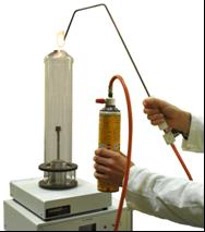
Example of specimen positioning and ignition in the test column.
Meaning of the Measured Value
The measured value represents the transition point between sustained combustion and self-extinguishment according to the method criteria. Reliable and comparable results require strict control of the gas mixture, flow conditions, specimen geometry, material conditioning and ignition procedure.
Reference Standards
| Standard | Subject | Scope |
|---|---|---|
| ASTM D2863-23e1 | Minimum oxygen concentration that supports candle-like combustion | Plastic materials |
| ISO 4589-2:2017 | Determination of the Oxygen Index at ambient temperature | Small vertical specimens |
Noselab ATS Automatic System Technology
In the EA04 system, the oxygen concentration is measured using a paramagnetic transducer. Microprocessor-based control enables direct reading of the measured values, automatic flow control, and oxygen/nitrogen mixing. Testing and calibration procedures are managed via a 7-inch color touchscreen.
| FUNCTION | DECLARED CONFIGURATION |
|---|---|
| O₂ Detection | Paramagnetic transducer, O₂ accuracy < 0.1% |
| Flow Control | Automatic via mass flow controller |
| Mixing | Automatic oxygen/nitrogen control |
| Control | Microprocessor and 7” color touchscreen |
| Calibration | Automatic at 0% and 100% |
| Gas Optimization | Option to add air for measurements at high oxygen concentrations |
| Connection | USB output for PC connection |
| Column | Type A Pyrex glass, Ø100 × 450 mm |
Why use a paramagnetic transducer?
Oxygen has paramagnetic properties that can be used to determine its concentration. In the context of the LOI test, continuous measurement of the O₂ percentage makes it possible to verify the composition of the mixture actually present in the column, rather than relying solely on nominal flow-rate values.
METROLOGICAL ADVANTAGEThe combination of concentration measurement and automatic flow control reduces the need for manual adjustments and helps ensure more stable and repeatable test conditions. |


Left: optional Data Link INDOX software. Right: holders for different types of specimens.
Applications in Laboratories and Industry
The LOI test is suitable for the comparative characterization of insulating materials, cable jackets, elastomeric and plastomeric fillers used in electrical cables. The principle can also be applied to research and quality control of other polymeric materials within the scope of the relevant standard.
| Industry | Materials / Components | Use of Results |
|---|---|---|
| Electrical Cables | Insulation, jackets and fillers | Comparison of combustion behavior |
| Polymers | Thermoplastics and flame-retardant formulations | Development of flame-retardant materials |
| Elastomers | Compounds and flexible components | Comparative evaluation of formulations |
| Foams | Self-supporting cellular materials | Product control and research |
| R&D Laboratories | Experimental samples | Screening and formulation optimization |
| Quality Control | Production batches | Verification of process consistency |
Conclusions
The Limiting Oxygen Index provides a quantitative parameter for comparing the combustion behaviour of polymeric materials. Reliable results depend on accurate control of the gas mixture, stable flow conditions and strict compliance with the standardized procedure. The NOSELAB ATS automatic system integrates paramagnetic oxygen measurement, automatic flow regulation, calibration and digital test management in a configuration designed for research and quality control laboratories.
Technical references: NOSELAB ATS Technical Datasheet rev. 3-2019; ISO 4589-2:2017; ASTM D2863-23e1.

CONTACT US
Browse the Noselab ATS catalogue: discover the equipment available!
Contact us now for more information
CONTACT US